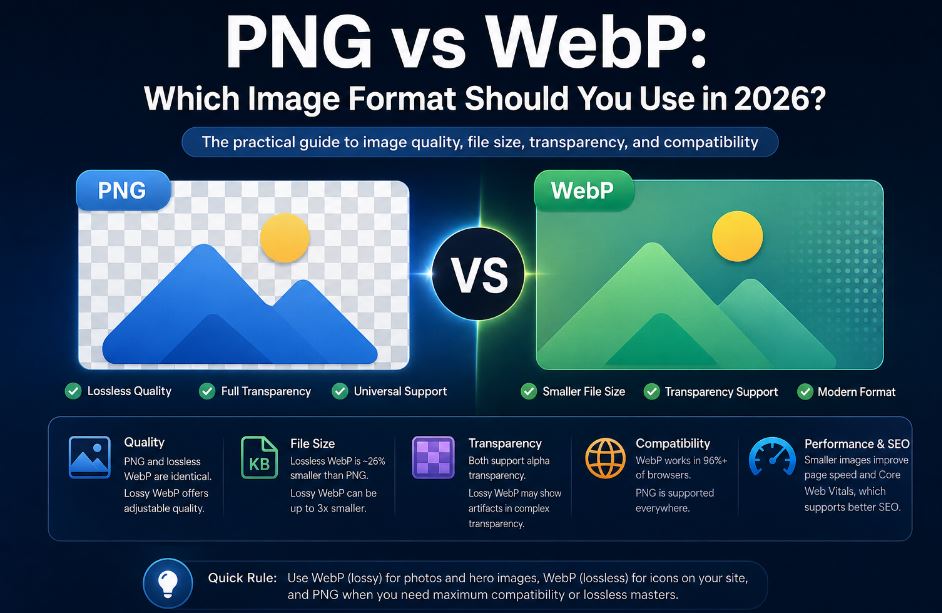
You have an image ready to publish, and your editor asks: save it as PNG or WebP?
The answer depends less on which format is universally "better" and more on what the image contains, how it will be used, and where it needs to work.
Choose poorly for a large website image and you may send more data to visitors than necessary. Choose a format that does not fit your workflow and you may run into compatibility problems later.
This guide compares PNG and WebP in practical terms so you can choose the format that makes sense for each image instead of using one format for everything.
What Is PNG?
PNG, or Portable Network Graphics, dates back to 1996 and was originally developed as a patent-free alternative to GIF.
PNG uses lossless compression. When a PNG is decoded, the image data is reproduced without the compression losses associated with lossy formats. This makes PNG useful when preserving the stored image information matters.
PNG compression works particularly well with images containing repeated patterns and relatively uniform areas of color, such as logos, icons, diagrams, and many screenshots. It is generally less efficient for photographs, where there is much more fine-grained variation between pixels.
PNG also supports transparency through an alpha channel and is extremely widely supported across browsers, image editors, design applications, and other software.
That combination of lossless compression, transparency, and broad compatibility is why PNG remains useful even though newer formats can often produce smaller files.
What Is WebP?
WebP is an image format introduced by Google in 2010 with the goal of reducing image file sizes on the web.
Unlike PNG, WebP supports both lossy and lossless compression.
With lossy WebP, some image information is discarded during encoding in exchange for a smaller file. With lossless WebP, the decoded image can reproduce the source image without those lossy compression changes.
WebP also supports transparency and animation, making it useful for a range of web graphics in addition to photographs. Google's documentation describes WebP as supporting both lossy and lossless compression for photographic, transparent, and graphical images.
There are some technical limitations worth knowing. WebP supports maximum dimensions of 16,383 × 16,383 pixels. For normal website images, this is rarely a practical limitation, but it can matter in specialized imaging workflows.
Lossless vs. Lossy: The Distinction That Actually Matters
The most important question is not simply:
PNG or WebP?
It is often:
Do you need lossless or lossy compression?
Lossless compression preserves the image information when it is decoded. PNG is lossless, and WebP can also be encoded losslessly.
Lossy compression deliberately removes some information to reduce file size. The goal is to make the visual difference small enough that the reduction is worthwhile. WebP supports lossy compression, while PNG does not.
This gives WebP an important degree of flexibility. You can use lossless WebP when exact reproduction matters, or lossy WebP when reducing file size is more important than preserving every piece of source data.
That flexibility is more useful than any single "WebP is X% smaller" statistic because the best setting depends on the image itself.
File Size: What the Research Actually Shows
WebP can be substantially smaller than PNG, but the exact difference depends on the image and the encoding settings.
Google's official WebP FAQ states that lossless WebP images are 26% smaller than PNG images in the cited study. That is a benchmark result from Google's testing, not a guarantee for every individual file.
Google's published lossy WebP research also found that WebP produced average file sizes 25–34% smaller than JPEG at equivalent SSIM quality in the datasets tested. That comparison is useful context, although it is a WebP-versus-JPEG result rather than a PNG-versus-WebP result.
These figures are useful for understanding WebP's potential, but they should not be treated as a promise for a particular image.
A photograph with complex textures, a flat-color logo, a screenshot, and an illustration can all compress very differently.
Two practical conclusions follow:
- If you have a photograph stored as PNG, converting it to a lossy web format can produce a significant reduction because PNG is not designed to exploit photographic data in the same way as lossy compression.
- If you have a graphic that must remain pixel-perfect, compare lossless WebP and PNG rather than assuming lossy WebP is appropriate.
The only reliable way to know how much smaller a particular image will become is to test that image.
Image Quality
With lossless PNG and lossless WebP, there is no lossy quality trade-off. The decoded image retains the source image information.
With lossy WebP, quality becomes a setting.
Higher-quality encoding generally produces a larger file while preserving more visual detail. Lower-quality encoding produces smaller files but increases the possibility of visible compression artifacts.
Photographs often tolerate this trade-off well because small changes in texture and color can be difficult to notice at normal viewing sizes.
Sharp graphics are less forgiving. Artifacts can become more noticeable around:
- Small text
- Thin lines
- High-contrast edges
- Icons
- UI elements
- Geometric shapes
For those images, PNG or lossless WebP can be a better choice when preserving sharp detail is important.
So "which format has better quality?" is not quite the right question.
The more useful question is:
Do you need exact image reproduction, or is a smaller file with visually acceptable compression more valuable?
Transparency
Both PNG and WebP support transparency.
This is important because transparency is not a PNG-only feature.
PNG stores transparency through an alpha channel, while WebP also supports transparency, including with lossy compression. Google's documentation explicitly lists transparent images among WebP's supported use cases.
For a simple logo with a transparent background, WebP can therefore be a practical alternative to PNG when the image is being delivered on a modern website.
Graphics containing soft shadows, gradual fades, or complex semi-transparent effects deserve more attention. Compression can affect the appearance of delicate edges, so the final output should be checked visually.
If preserving the appearance exactly is important, PNG or lossless WebP is the safer approach.
Matching the Format to the Image
The right format depends heavily on what is actually inside the image.
Photographs
PNG is generally inefficient for photographic content because its lossless compression does not reduce photographic data as aggressively as lossy image compression can.
For a photograph being delivered on a website, lossy WebP is often a strong choice when reducing file size is a priority.
If you need an original or archival copy, however, keep an appropriate master rather than treating the web delivery file as your only source.
Logos, Icons, and Flat-Color Graphics
Logos and icons can work well as PNG because their flat areas and repeated colors are relatively friendly to PNG compression.
Lossless WebP can often produce a smaller file while preserving the image, making it an attractive choice for assets that will remain on a modern website.
PNG can still be preferable when the same asset needs to move between different systems, software, or organizations where compatibility matters more than saving every last kilobyte.
Screenshots and Images With Text
Screenshots contain sharp edges, small text, interface elements, and other details that can reveal lossy compression artifacts quickly.
For these images, PNG or lossless WebP is usually a safer choice.
If a screenshot is saved using lossy compression, look closely at text and high-contrast edges before publishing it.
Website Hero Images and Banners
Hero images are often photographs or photo-heavy compositions, and they can be among the largest individual assets on a webpage.
For this type of content, lossy WebP can be useful because reducing the image's file size can reduce the amount of data the browser needs to download.
The important point is not simply "hero image = WebP." The real goal is to choose an image format and compression level that provide an acceptable visual result at the smallest practical file size.
Website Performance and SEO
Images can account for a significant portion of a webpage's download weight. Large images therefore have the potential to affect how quickly a page loads and how users experience it.
This is particularly relevant to performance metrics such as Largest Contentful Paint (LCP), where a large above-the-fold image can become an important part of the loading experience.
But there is an important distinction:
Using WebP is not, by itself, a direct Google ranking boost.
The benefit is indirect. A properly optimized image can reduce the amount of data a browser needs to download, which can contribute to a faster and more efficient page.
Google's WebP documentation describes the format's purpose in terms of creating smaller images that can help make the web faster.
So the useful SEO question is not:
"Does Google reward WebP?"
It is:
"Can this image be delivered efficiently without sacrificing the quality users need?"
That is a much more useful way to think about image optimization.
Browser and Platform Support in 2026
WebP is now supported by all major modern browsers, so browser compatibility is no longer a significant concern for most public websites. Google's current WebP documentation lists native support in Chrome, Edge, Firefox, Opera, and Safari 14 and later.
PNG has a different advantage: it is extremely well established outside the browser.
That difference can matter when an image needs to move through systems that were not designed around modern web formats.
For example:
- Email: WebP support varies between email clients and workflows, so PNG or JPEG can still be a safer choice when broad compatibility is important.
- Legacy software: Some older applications or upload systems may accept only a limited set of traditional image formats.
- Print workflows: Professional print workflows often use formats such as TIFF or PDF, but PNG may still be accepted more readily than WebP by some systems.
- Specialized color workflows: Certain professional workflows may require capabilities beyond what WebP provides.
For a normal modern website, however, WebP compatibility is generally no longer a major obstacle.
Which Format Should You Choose?
| Image type | Recommended format | Why |
|---|---|---|
| Photograph for a website | WebP (lossy) | Can substantially reduce delivery size while maintaining good visual quality |
| Logo or icon staying on your website | WebP (lossless) | Often smaller than PNG while preserving the image |
| Logo or icon also used outside your website | PNG or WebP depending on compatibility | The receiving system may matter more than file size |
| Screenshot or image with small text | PNG or lossless WebP | Preserves sharp edges and text |
| Archival or editing master | Native/source format when available | Keeps the original workflow independent of a delivery format |
| Lossless raster export needed | PNG or lossless WebP | Both can preserve the image without lossy compression |
| Email asset | PNG or JPEG depending on the workflow | Compatibility can be more important than format efficiency |
| Website hero image or banner | Usually WebP (lossy) | Large images can benefit from efficient compression |
Use the table as a starting point, not a rigid rule.
The underlying questions are:
- Does the image need to be lossless?
- Where will the image be used?
- How important is compatibility with other software or platforms?
- How much can the file be compressed before the visual quality becomes unacceptable?
A Practical Workflow
A sensible workflow is to separate your master file from your web delivery file.
Keep the original design or source file when one exists. Depending on the project, that might be a native design file, a high-quality raster export, or another source format.
Then generate the appropriate delivery format for the website.
For many modern websites, that may mean generating WebP versions of images that benefit from smaller file sizes.
If you start with a PNG and need a WebP version, you can use Cookify's Image to WebP converter to perform the conversion. The tool's page also states that it supports transparency and batch processing.
If you have a WebP image and need a PNG version for a different workflow, Cookify's Image to PNG converter provides the reverse conversion. Its page states that it supports alpha-channel retention and batch processing.
Before replacing important original files, keep your source/master asset separately. A web delivery format should not become your only copy of an important image.
The Bottom Line
There is no single winner between PNG and WebP.
For many images delivered through modern websites, WebP is often the more efficient choice, particularly when reducing file size is a priority.
PNG remains valuable when you need lossless raster output, broad compatibility, or a workflow that specifically benefits from its capabilities.
A practical rule is:
- Website photograph: WebP is often a strong choice.
- Website logo or icon: Try lossless WebP and compare it with PNG.
- Screenshot with small text: PNG or lossless WebP.
- Image that must work across older systems: PNG may be safer.
- Important original/master: Keep the native source or an appropriate lossless master.
- Not sure: Compare the actual files rather than relying on a blanket rule.
In practice, many websites use both formats deliberately. The best choice is the one that gives you the required image quality, compatibility, and file size for the specific job.